“Don’t let the facts get in the way of a good story.”
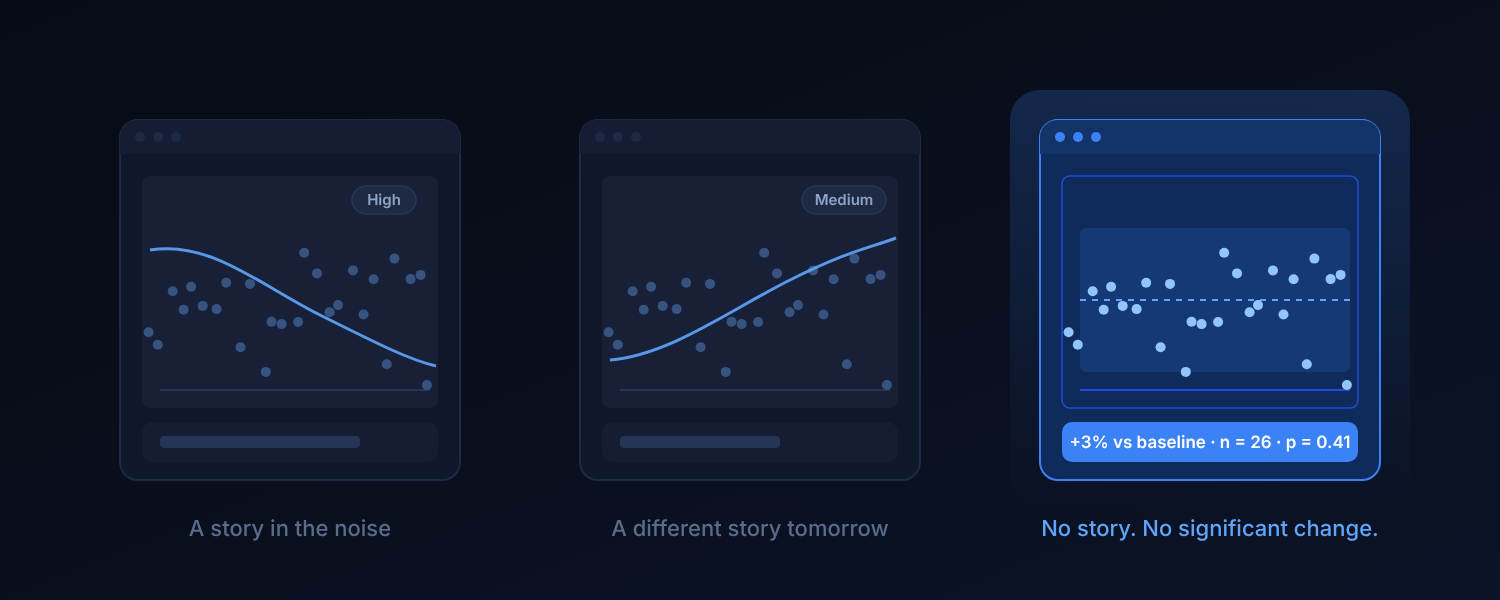
The Five Parts of a Decision, part 2 of 5.
Every recommendation Aviio makes carries a confidence label, because nobody should move budget on a finding without knowing how sure the system is. While I was building that feature, before I'd codified the statistics behind it, I wanted to see how a frontier model would do, so I handed it the results of an analysis and asked for a confidence label. It said "High," and I thought, sweet, I solved marketing. Then I asked if it was sure, and it said "Medium," so I asked for the R². It was 0.2.
For the non-statisticians: an R² of 0.2 means the pattern it found explains about a fifth of what happened, and the other four fifths it has no idea about. It had made a confident call on evidence that couldn't support one. I caught it because I knew to ask for the R² and knew what 0.2 meant when it came back, which most people running ads wouldn't, and shouldn't have to.
Yet they're increasingly being asked to make budget decisions on what a model tells them. The pressure to put AI into every marketing decision has never been higher, and most of the tools answering it hand the diagnosis to a language model. From the outside you can't tell, because the summary reads the same whether there's a number underneath it or not.
And that's the problem with a language model doing the diagnosing. It tells a story, a compelling one, and it'll find one no matter what you ask and no matter what it finds.
Where we are
The problem wasn't the caliber of the model but three things language models do by construction, and they stack.
It found meaning in noise. An R² of 0.2 means there's nothing there but noise, and the model found a pattern anyway, because finding patterns is its job. A pattern recognizer reads scattered, volatile, enormous data and pulls out the common threads. And since that describes every ad account ever built, these models look like a gift to marketing: finally, something that can make sense of the mess. The trouble is that in data like marketing's there is always a story to tell, and usually too many. A campaign whose CPA drops 38% on a dozen conversions has a story, but it's probably a "normal week." The true job of marketing diagnostics is distinguishing meaning from noise, and a recognizer can't, because to a recognizer everything is meaning. In other words, an LLM won't tell you nothing happened, and you can't make a decision off noise.
It had the facts and told the story anyway. The 0.2 was in the material I gave it, but the "High" didn't come from the 0.2: it came from the same place the story came from, the part of the model whose job is to make sentences sound right. A 2024 paper at ICLR asked the question in its title, "Can LLMs Express Their Uncertainty?", and found that when models rate their own confidence, they skew overconfident, the way people do. Confidence from a model is a tone of voice, not a measure of how certain the finding is.
The story changes every time you ask. Ask if it's sure and it changes its mind. Ask again tomorrow, same numbers, and you'll get a different story, just as specific and just as sure. Each is the most plausible sentence the model could produce in that moment, and the moment changes. If the same numbers can produce two findings, neither was a finding. Pinning the model's settings so it repeats itself doesn't fix that, because the finding has to come from a test, not from the model. All pinning does is make the same guess every day, and a wrong finding you can reproduce is the most dangerous kind: it looks exactly like a right one. And you can't make a decision off a tool that, by nature, gives a different answer every time you rerun it on the same data.
Three failures, one experiment. The usual response is that I asked badly: write a better prompt, build a workflow around it, hire someone whose whole job is the asking. Fair enough. For the sake of argument, let's play that out. Say the question is creative fatigue: is this ad wearing out? Tell the model not to call fatigue unless the fit clears an R² of 0.8, and it won't. But do that and you've just written the first rule of a statistics engine. The diagnosis just moved out of the model.
Then an ad on a few hundred impressions a day gets flagged as fatigued, because R² says how well the line fits and nothing about how thin the points were, so you write a second rule: under a minimum of impressions, say nothing. Then the second rule still flags an ad you swapped on Tuesday, which has plenty of data and looks fatigued on Thursday because the platform is still relearning it, so you write a third. By the fifth you're checking each one against what really happened, and rechecking when a platform changes its defaults overnight. See where this is going? Every rule you add moves the diagnosis further out of the model (which is the right direction) and onto you (which is likely the wrong desk). And that was one question. You have dozens.
But look at what those rules are, and what you're actually building. They're the confines of the story, what engineers would call an AI harness, and the model is the thing inside it. You never set out to build an AI harness for marketing. That's not your job.
Left to itself, a storyteller will tell you a great tale, and you don't fix that. You set the facts and let it write the prose.
Where we need to be
At Meta, we could tell a stakeholder what they didn't want to hear because the number came first; the story was whatever it would support. The harness has to hold the model to the same order, and that takes three properties, one for each failure.
The first is statistically sound, because statistics exists for the one question a pattern recognizer can't ask: is this real, or would I have seen it anyway? The number has to pass that test before it earns a sentence, and if it doesn't, it's noise with a narrative.
The second is grounded in the facts, which means the number isn't an input to the story but the permission for one: the model speaks only after the number has, and only about what the number said. The facts don't get in the way of the story. They decide whether there is one.
The third is deterministic: same data in, same finding out, every time. At Meta, if I refreshed an analysis and it came back with a different result, it was broken. If a diagnosis can change without the data changing, it isn't a diagnosis. It's a coin flip with good grammar.
A system like that says less than a storyteller would, because it only speaks when the number does, and the surest sign a diagnosis can be trusted is that it's also willing to say "nothing happened," or "not enough data yet."
The test
It works on any tool, and it has three parts, one for each failure.
First, ask it about a campaign you already know was steady: normal numbers, nothing changed, a week you've looked at yourself. If it finds you a story and a move to make, it found a pattern in noise, and it will do the same on the weeks you haven't checked.
Second, ask what the finding rests on: what's the baseline, how big is the change against it, how many conversions is it built on. If what comes back is more sentences, the story came first and the facts never showed up.
Third, ask it twice, same question, same date range, new session. The wording can change, but the finding can't. If one day it's the audience and the next it's "within normal range," nothing diagnosed your account. Something described it twice.
What Aviio does
Aviio is built to that bar, so every finding is statistically sound before it's anything else: tested against your own baseline, on enough conversions, by more than chance would explain. It's grounded in the facts: if the test fails there's no card and no story, and if it passes the model writes only what the numbers support. And it's deterministic, which means that tomorrow, on the same data, it says the same thing. The facts go first. The story is whatever they'll support.