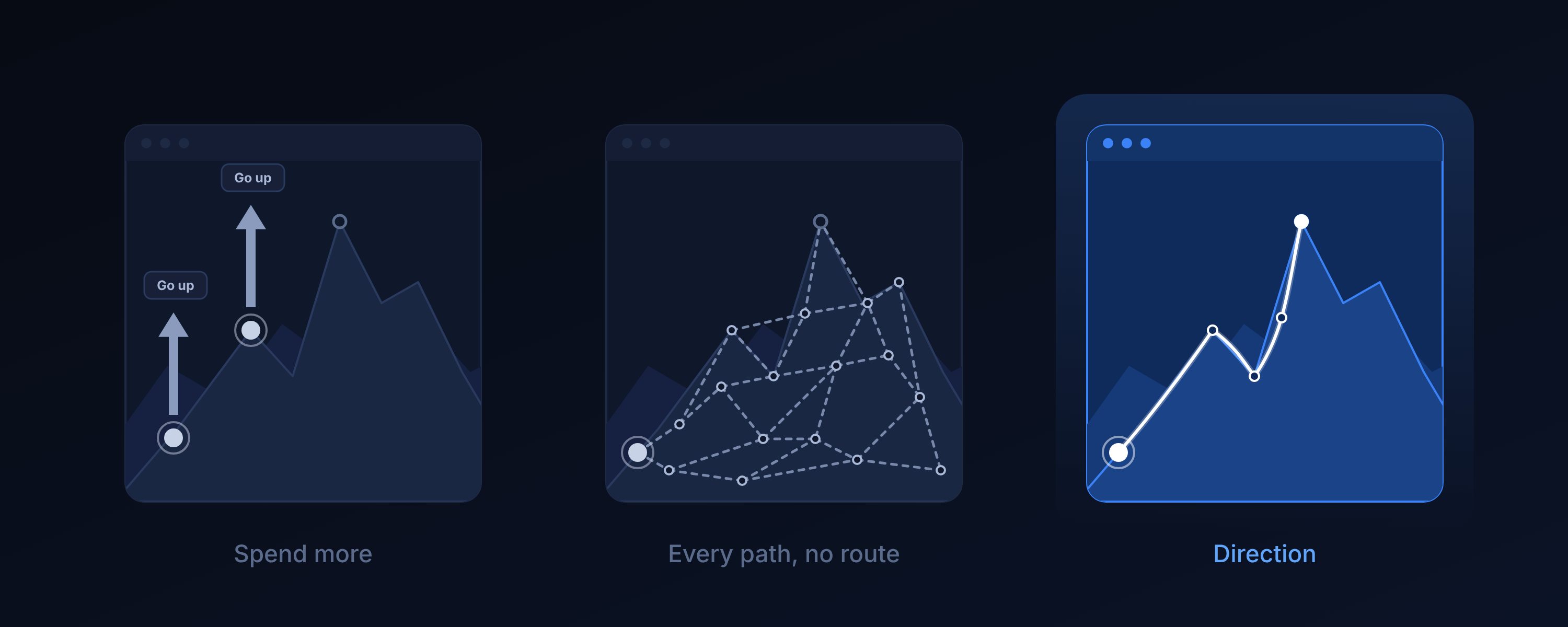
Twenty recommendations to spend more isn't direction. It's an expensive to-do list.
The Five Parts of a Decision, part 3 of 5: Recommendation.
When I was a marketing data scientist at Meta, I did the work your analytics team does: funnels, holdouts, where the next dollar should go. I just didn't do it for you. I measured revenue lift, for Meta. When a campaign of ours got advertisers to spend more, it worked. What those advertisers got for their money wasn't a number on my dashboard, nor was it a number my team was measured on.
That isn't a confession. It's the reality of ad platforms as a business, and it's the backdrop of the recommendations they give.
At Meta, the recommendations I gave did three things. They answered to one goal, ours. They were made at the level our marketing executives operated, the whole budget. And they accounted for everything else we were already doing. That's what a recommendation looks like from the inside. The ones you're getting miss on all three.
Where we are
Think about where your recommendations come from today. The recommendations tab in each platform, with its "apply all" button. The auto-optimizer, Advantage+ or Smart Bidding, that asks for a bigger budget and less control. Often the advice is good, but if you've ever felt like it always ends with you spending more money, that's not a coincidence. Three realities about an ad platform's business show who its recommendations ultimately report to:
- No single advertiser matters. Meta has more than ten million advertisers, its top 100 make up about 6 percent of its ad revenue, and both Meta's and Google's annual reports say advertisers can walk at any time. If one of the hundred biggest advertisers is a rounding error, you are too.
- Substitution is limited. You go where your buyers are, and your buyers are on the big platforms. Google, Meta and Amazon take about 62 percent of US digital ad spend, so a platform doesn't have to earn your budget each quarter to keep it.
- The clock is quarterly. Every platform reports ad revenue to Wall Street quarterly, so the business inside is measured on this quarter's lift, not on what its advertisers earned over three years.
Put those together and the rational move for a platform is to maximize spend per advertiser this quarter, because advertiser success is a long-term problem and the business runs on quarterly cycles. Nobody inside has to be a bad actor for that to be true; the people inside are rational actors playing the game they're measured on, and it's a different game than yours.
So the recommendations are biased. That's the first of the three misses, and the obvious fix is to stop taking advice from the platform and get it from a neutral third party. But a neutral number is only the first step. Neutral doesn't mean the tool operates at the level you do, and it doesn't mean the tool thinks about how its recommendations affect each other.
The second miss is the level. Every recommender has a wall, the edge of what it can see, and it can only make calls about what's inside. The platform wall is the obvious one: Meta can't see Google, so "move spend to Google" will never come from Meta, and its best advice covers a portion of your budget as if the other parts didn't exist. They do.
But the platform is only one kind of wall. Brand and performance are walls. The stages of your funnel are walls. A performance recommender says cut anything above target CPA. From inside the performance wall that's correct, but it's also blind: the campaigns above target were the ones reaching new customers, and the ones below it were retargeting people who'd have bought anyway. The performance recommender can't see the difference, so it can't weigh it. Right alone, wrong together. Marketing doesn't work in silos. Spend in one place moves outcomes in another, and a recommendation made inside one wall is a recommendation about part of a connected problem, however good it is.
The third is coordination. Recommendations are made one at a time, as if none of them affect the others, and in marketing all of them do. Scaling one campaign makes the audience of another more expensive. Raising one ad set's budget starves the ones sharing it. Pausing retargeting while scaling the prospecting that feeds it leaves the new prospects with nowhere to go. This is the hard part, and it's why nobody has done it yet. It's easy to generate twenty recommendations, but twenty recommendations is over a million potential scenarios, and sorting them out is left to you. A list of recommendations to spend more isn't direction. It's an expensive to-do list.
The solution doesn't take a longer list, more data, or more recommendations. It takes understanding that this is a different problem from optimizing a campaign. It takes understanding that decisions in marketing are connected. It takes understanding that the actions you take change the environment you take them in. You don't need more recommendations, you need direction.
Where we need to be
The people I handed recommendations to didn't run a campaign. They ran a program, and they were judged on one number. A recommendation that didn't fit that scope, answer to that number, and take their other strategies into account was not actionable to them, however clever it was. That's the bar, and it has three parts, one for each of the three things above.
Aligned. Not just neutral or independent. The recommender's definition of success is your definition of success, not a platform's revenue and not a score it made up for itself.
Holistic. The recommender's wall is the edge of your business, not the edge of a platform: every channel, brand and performance, every stage of the funnel. A call about one part is made with the rest in view, and the money can move between them.
Coordinated. The calls account for each other. Each one is made knowing what the others would do to the same budget, the same audiences and the same KPI, so what lands on your desk is one plan, not twenty.
None of these is a feature. Together they're an architecture. Put all three in one recommender and the twenty calls collapse into a plan: one number, one budget, one set of moves that know about each other. Leave any one of them out and you're back to the to-do list.
The test
Three questions, each one you can run on your tool this week. Together they tell you what it was built to do.
Ask for the last recommendation that went against its own interest. From a platform, that's "spend less here" about itself. From a third-party tool, it's "your number is fine, do nothing," said against the score it sells you. If there isn't one, you've found who it works for. Advice that only ever asks for more was never advice. It was a sales motion with a confidence interval.
Ask it to move money across a wall, and to say where the money comes from. Meta to Google. Performance to brand. Prospecting to retention. The first wall it can't cross is the edge of its advice, and every dollar it tells you to add on its side of that wall comes out of the side it can't see.
Apply one recommendation, then look at the rest the same day, before the data moves. If none of them changed, none of them knew. Each was made as if the others didn't exist, and working out what each one does to the others is yours.
Pass all three and the tool is advising on your business. Fail any one and it's advising for its own number, inside its own wall, one call at a time. No update fixes that. It's what the tool was built to do.
What Aviio does
Aviio answers to your objective, not to a platform's and not to its own. Its wall is every paid platform you run and the funnel behind them, read as one budget, so every reallocation names what gets cut and what gets funded, in dollars. And each recommendation is made knowing what the others would do, so what you get is one plan. Brand and lifecycle are walls still standing; the bar is higher than the product, and it should be. The card in the launch letter moved $1,800 a month off Meta. No platform would have written it. That's the point.
Next week, part 4: Rationale. Why a recommendation has to show its work before you take it.