The home screen is a tell. You're still paying for access to your own data.
The Five Parts of a Decision, part 1 of 5: Observation.
For as long as I can remember, I've loved turning a mess of information into something a person understands in one look.
As a consultant, I spent hours nitpicking the details of slides, because a good one ends a debate before it starts. As a data scientist, I built dashboards that turned gigabytes of data and a dozen pipelines into one number a team could agree on. I loved it, and I built a career from it.
But as a founder, I just want to know what I should do this week.
Nothing I used to build would tell me. A slide makes a point legible and a dashboard makes a number visible, but neither one makes a decision. Someone still has to look at the number, decide what it means, decide what to do about it, and explain it to their team. At Meta, that someone was me; I was paid to show up with an opinion. For most marketers, it's them, alone, after the dashboard loads. It's the part of the job they were hired for.
Recently the tools learned to talk, and it looked like that might change. At Advertising Week this month, the standing-room session was "The AI-Native Marketing Organization," and the home screen on stage was a text thread with suggested questions underneath. Good questions, but still questions. Somebody still had to walk up and ask them, and somebody still had to decide what to do with the answer.
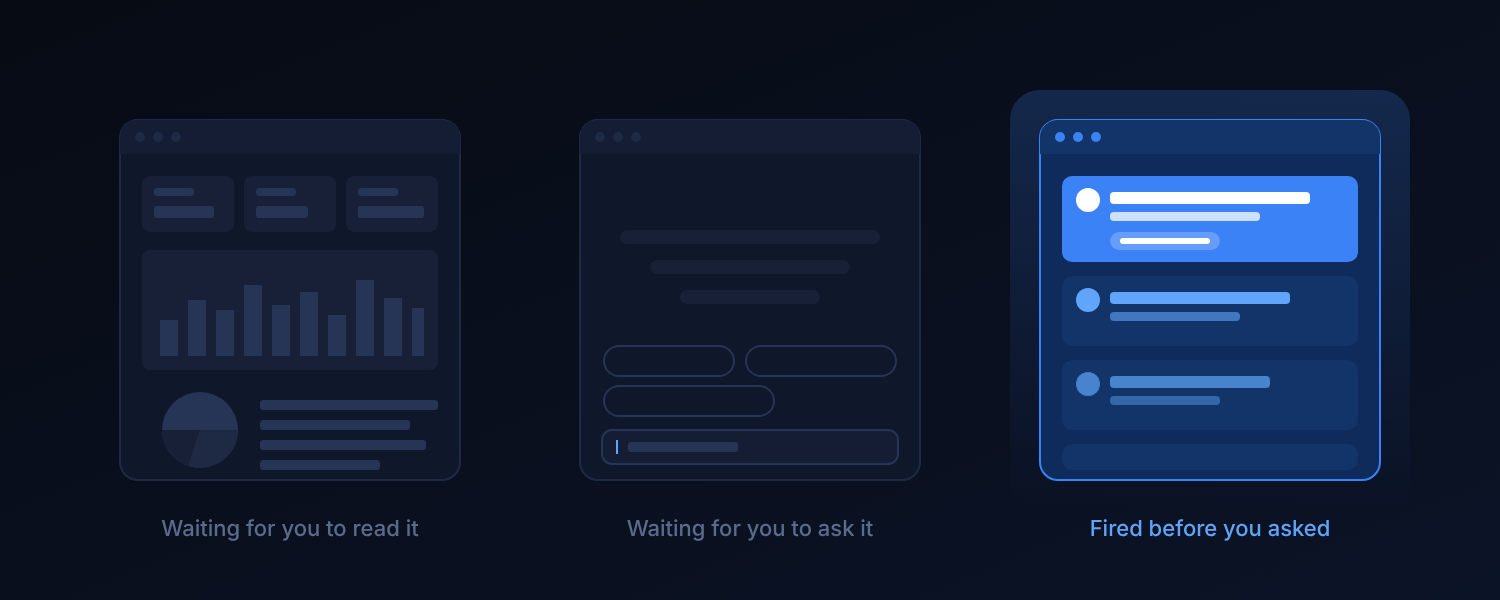
That's why the home screen is a tell. A grid of charts waits for you to read it. A text box waits for you to ask it. Either way the tool is waiting, and the two hard parts, the question and the call, are still yours.
So here's what I actually want on a Monday. Not a faster answer. What matters this week, and what to do about it, before I've asked.
Where we are
Dashboards solved access, and for fifteen years the industry answered "what matters" by stacking more views on top. More breakdowns, more filters, more segmentations (and unbecoming of us all, more pie charts). Then came the chatbot. Every marketing tool shipped one this year, and most of them are good. Ask a question about your account and you get real analysis back, faster than you'd have found it yourself. The agent is fine. But the chatbot didn't replace the dashboard. It replaced the way you talk to it.
The problem is what a chatbot is for. It's built to answer, and answering was never the hard part. The hard parts are knowing what to ask, and knowing what to do with the answer. On my first day at Meta, with zero knowledge of the business, I was expected to answer queries. That was the floor, not the value. The value only showed up when I came with an opinion. A bot that waits for a question is a query tool with better manners, and it hands both hard parts back to you.
You don't lack answers. You lack the question, and in a market this volatile nobody can always know the best next one. Auctions shift, audiences fatigue, a platform changes its defaults overnight. The right question this week didn't exist last week.
Two generations of tools, but look at what each one sold you… The first sold you access to your data. The second sold you access to answers about it. The industry has sold access twice and called it progress both times. Neither generation moved the noticing, and neither moved the call. The thing that quietly costs you the quarter is the one nobody had a reason to look at. An observation you had to request is a search result. An answer with no move attached is a report.
Where it needs to be
At Meta, a marketing leader could get any answer by asking. There was a team of us for that. But we were data scientists. We were there to chase open-ended questions and find the thing nobody was looking for, not to be finance's reporting arm. Finance had people for that. We were most valuable the day we walked into the room with something nobody had asked for: a finding they didn't know to look for, with the number behind it and the move it implied. Proactive, and on our own initiative.
Here's why asking can't get there. Take one campaign. Three ad groups, four ads each, five headlines and three descriptions per ad. Each ad can assemble itself fifteen ways, so that's 180 versions of the campaign. Add four placements and two devices and one campaign is showing up 1,440 different ways, each with its own numbers, none of them picked by you. And that's treating the audience as one thing. It isn't. The platform is slicing it into segments you never see, and every one of those 1,440 performs differently in each. Nobody holds that in their head. And you can only ask about what you already suspect. The expensive problems are the ones you don't.
That used to be a hard limit, and the tooling shows it. Tools grew up in sections because the practitioners did: an attribution tool, a brand measurement tool, a bidding tool, each watching its own slice, each with a specialist behind it. Now that the practitioner can be software, the slices don't have to stay separate. The whole operation can be read at once, at every level, every day.
So the bar is a holistic read of the whole operation, every level of it, running on its own, that brings you what you didn't ask for. Not a view you open. Not a box you type into. Something that was already looking.
And it has to know when to speak. A tool that flags everything is noise on a schedule.
What loads first
The test takes one morning. Open your tool cold on Monday, before you've looked at anything else, and ask one question: did it fire before I asked?
If what loads is something waiting for you, a grid, a box, a report you scheduled, then both hard parts are still yours. If what loads is what it found since you last looked, ranked, with the move attached, then the first hard part happened without you, and the second is on the screen.
None of this means dashboards go away. When CPL spikes on a Tuesday and you want to know why, you need the views. Investigation is a real job. It's the layer underneath, not the layer on top.
What Aviio does
Aviio's home screen is that list. Every platform, every campaign, every keyword and audience under them, read every day, and what it found since you last looked, ranked, with the move and the reason attached. The dashboard is one click away. You didn't ask. It fired anyway.