“+79% more conversions.” Made for your account, or from it?
The Five Parts of a Decision, part 5 of 5: Headroom.
Have you ever wondered where the numbers behind platform recommendations come from? I was behind a few of those at Meta. Ones like the Google example I wrote about last week, which projects a 79% increase in conversions:
Get more leads through Google-hosted lead form ads
Recommended because advertisers who adopt lead form ads get on average 79% more conversions at a similar CPA
People often feel like these numbers are conjured to drive adoption, and while they may not be sales-agnostic, they are not put before you lightly. They arise from platform-run studies that include rigorous statistical and legal reviews.
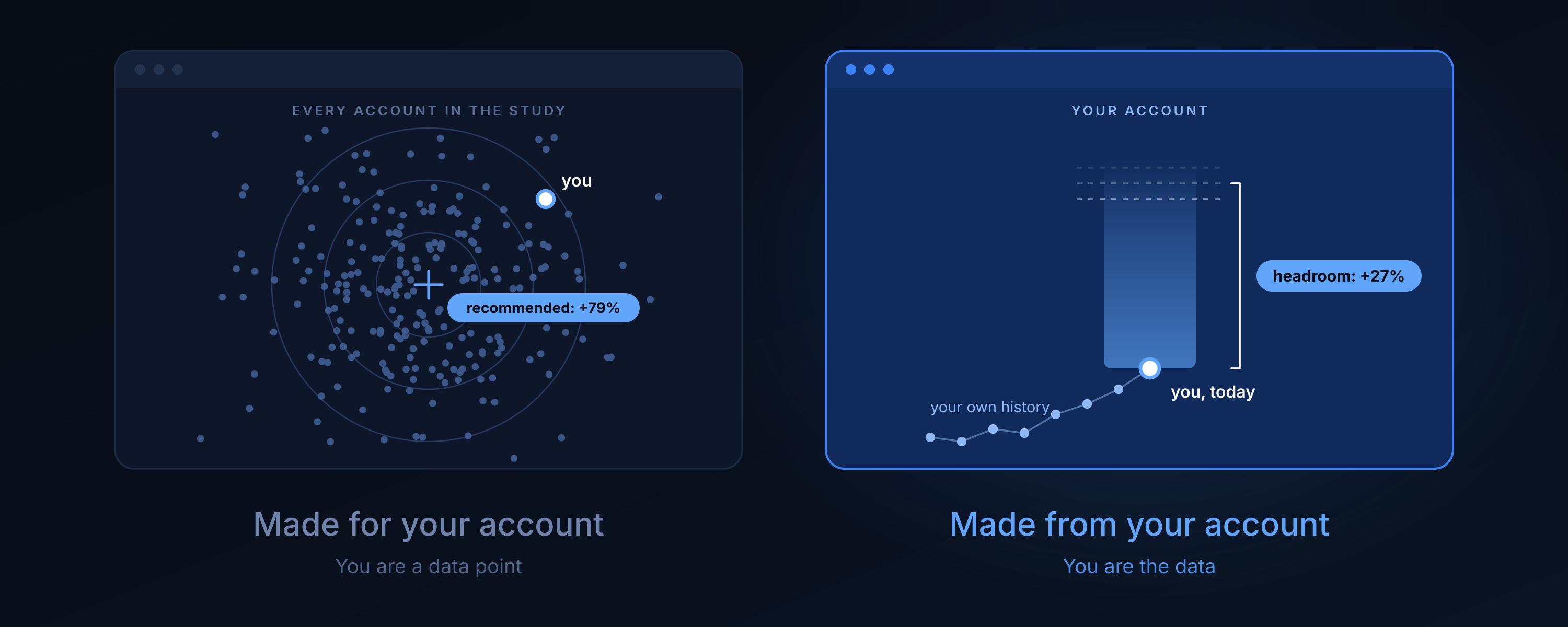
The validity of the number is not in question, its usefulness for decision making is. These numbers come from studies run on the platform's side, where you are one row in a table of hundreds of thousands, if not millions. They are statistical averages of platform outcomes, not projections tailored to your advertising. Averages are great at measuring outcomes across a population, but bad at predicting individual ones.
The 79% was a projection made for my account, not one made from it. That difference is the focus of this letter, which isn't a critique of platforms, or of statistical averages, but rather of the notion that the average of others is the best projection for you.
Where we are
Take the example Google gave me. The projected increase in conversions could mean content downloads or demo requests. These events have vastly different values to a business, and that difference has to be understood when quantifying the opportunity. The first response here is "Why don't you wire the value of events into the conversions?" I did. It makes no difference, because these recommendations take months of statistical and legal review, and the number is settled long before it reaches my account. Having that amount of work behind them is a good thing, but it also means they cannot be attuned to the nuances and fluctuations of your business.
These numbers are not only denominated in generic conversions rather than dollars or your key KPI, they are often ignorant of how your business has been performing. Say you are already well optimized, growing every week, and driving 1,000 conversions a week - you have little room left to grow, and a 79% increase (790 a week) is not a realistic expectation. Conversely, if you are flatlining at 10 a week, you have plenty, and 8 more may undersell it. To hand both the same projection is statistically defensible, and it ignores the one thing that separates them, how much room each has left. These numbers cannot be agnostic to your recent performance, they need to be grounded in it.
The biggest qualm I had with the +79% number was the twelve others sitting on my screen for other recommendations. They all, by nature, have the same problem, but more importantly, they were presented as distinct, as in do one and the others are still sitting there unchanged when you refresh. Nothing in marketing happens in isolation, and treating these projections as independent events makes the problem worse. The gold standard for a projection is incrementality: what would this action add over everything you're already doing? That is hard to know, and I don't hold a recommendations tab to it. What I do expect is the step before it, a number that knows about the one sitting next to it, and these fall short of even that. And that seems to be the status quo today.
An average can be exactly right about the hundreds of thousands of accounts it was drawn from, and still tell you very little about any one of them. That makes it a fine input into a decision, but it shouldn't dictate one.
Where we need to be
Let me introduce, or perhaps re-introduce, a term: headroom. Headroom is the room a move has to improve your number: what it should add, starting from where you are today. It is a projection like the 79%, with four differences.
Priced: Headroom is denominated in the KPI you care about, not a generic 'conversion', and not a platform's optimization score. Knowing how a decision will impact your bottom line, rather than generic funnel metrics, is how you'll sell and defend the move to your boss.
Grounded: Headroom is rooted in, and derived from, your marketing history, not asserted as the expected outcome because, on average, thousands of other advertisers saw it. It starts from where you are today, and how much room you have left to grow, which is the part an average of everyone else can never know.
Connected: Headroom is aware of the other moves in front of you. Act on one, and the numbers on the rest adjust. If the estimates on your recommendations don't adjust to your account's performance, or to each other, they are stock averages.
Incremental: At its best, headroom tells you what a move adds on top of everything you're already doing. It is the gold standard of marketing decisions.
Headroom is still a projection, and it can still be wrong. It's one made from your account, which is why you can make a decision on it.
The test
Three questions for the number next to any recommendation:
Ask what population it was taken from: your account, or an average over other advertisers. If it started from theirs, ask what moves it toward yours.
Ask what unit it's in. Can you make a decision off of it as it stands, or do you first have to translate it into the unit you care about, dollars?
Ask what happens to it when you act on another one. Take one recommendation and refresh. If the numbers on the rest are still sitting there unchanged, they were worked out one at a time.
Three straight answers and the number was made from your account. Without them, it was only made for it.
What Aviio does
Every Aviio recommendation is a card, and every card carries its headroom. Take the lead form recommendation from the top of this letter. On a card, the number next to it is priced in the KPI you told us you answer for, so a demo request and a content download stop counting as the same thing. It is grounded in what your own campaigns have done, so the firm driving 1,000 conversions a week and the firm driving 10 don't get handed the same 79%. And it is connected, worked out with your other open cards in view.
I spent years making numbers that were sound, and made from everyone else's results. Aviio exists to make one from yours.
That's the five. Observation, diagnosis, recommendation, rationale, headroom: one test each, five tests to run on any tool before you let it near your budget. The checklist the first letter promised, collected in one place, is next.