“Show me.” A rationale's job is to inform you, not persuade you.
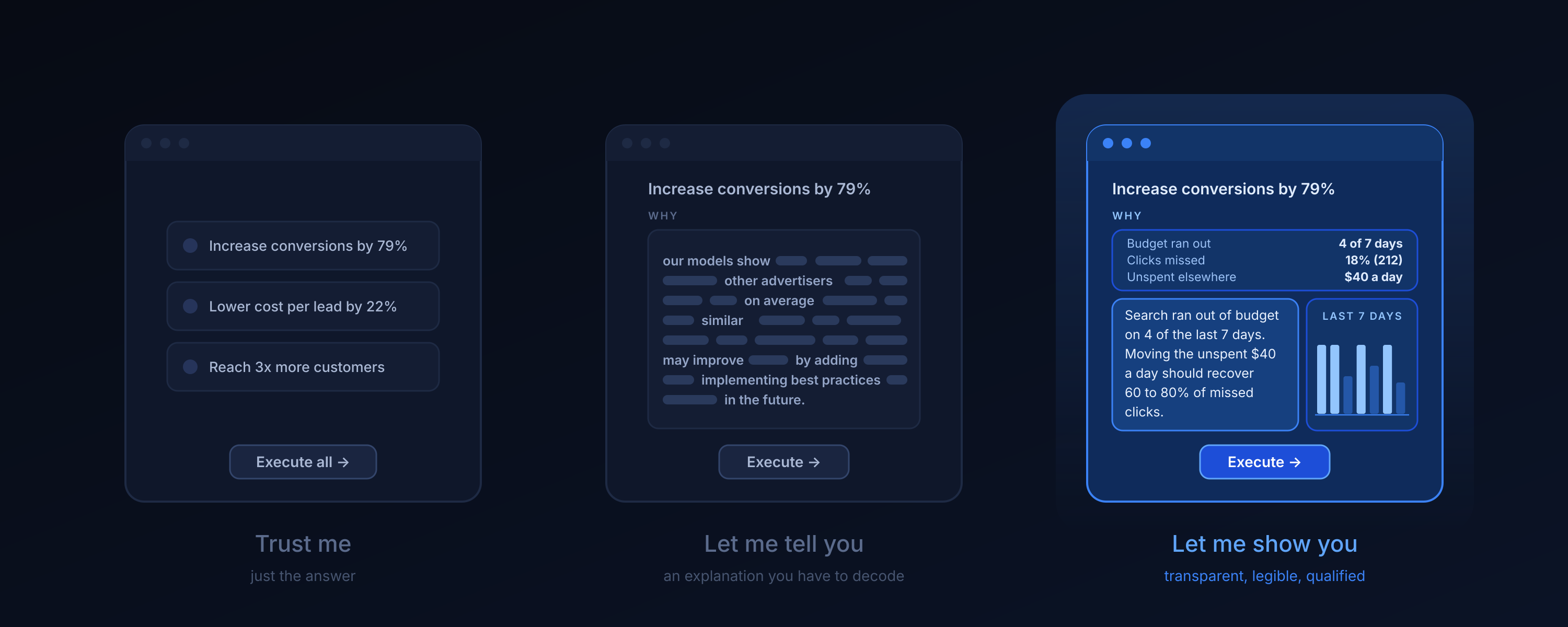
The Five Parts of a Decision, part 4 of 5: Rationale.
"Why would any of your clients listen to your advice?" A family member asked me that one Thanksgiving, and I've never forgotten it. I was fresh out of college with a consulting gig, advising mid-career professionals in a field I had never worked in. It was a fair question. Why were they listening to me?
What I said then is still true today: my clients weren't listening to me. They were listening to what the evidence said. Nobody in that room was taking a 22-year-old's word for anything, and they certainly weren't taking it because I could write good prose. What was in the explanation did the work. It showed where each claim came from, what it meant, and how far it went. Those three things made it trustworthy. My job was to put it all together so that nobody had to take my word for it.
So even with no "trust me" credentials, they listened. Now I have some, as a former Meta data scientist, and the bar hasn't moved. This summer I was demoing Aviio to a marketing leader, and after reviewing a decision card she said: "Show me the evidence." The card already had a number, a move and a confidence label, but it still wasn't enough. She was asking what those other clients were asking: can I trust this? Credentials never answered that. A good explanation did.
You can have an insightful observation, a grounded diagnosis, and a specific recommendation, but without a sound rationale for why you should act on them, you won't.
Where we are
Every recommendation in Google Ads carries a line that begins with "Recommended because." That line is the rationale. Here is one from my own account, with the rationale in bold:
Get more leads through Google-hosted lead form ads
Recommended because advertisers who adopt lead form ads get on average 79% more conversions at a similar CPA
On its face, that's 79% more conversions for one simple change. Here are a few follow-up questions your boss will have:
1. "How do you know?"
Well, you don't, and you can't check. The evidence is based on "advertisers," not marketing operations similar to yours. Is it all advertisers? Is it advertisers with audiences more likely to fill out lead forms? Without knowing who the guidance is based on, you can't be certain it's the right guidance for you.
Which is the issue: the explanation is a black box saying "trust me." Click into the recommendation and you get the same sentence again, plus the campaigns it applies to. Nothing shows where the 79% comes from, and you can't verify it holds for your account unless you spend the money to find out. I couldn't say "trust me" at 22 with no credentials, and I can't say it now that I have some, because credentials were never the point. The onus is on the explanation to show its work, and Google's name on it doesn't lift that.
2. "So what does that mean, precisely?"
Google's explanation is concise, but it isn't clear, and it's arguably misleading. It reads as: do X, get more Y. Fair. But when you note that 79% more conversions at a similar cost per conversion equates to about a 79% increase in spend, you realize it's basically just telling you to spend more to get more. That may be a fine trade, but the recommendation never tells you it's a budget decision. A rationale you have to decode hasn't explained anything, and that alone is a reason not to trust it.
3. "So this will work?"
But say you're willing to trust the recommendation and understand that it's pay to play. What can you expect to happen after you act? The recommendation makes two claims about that, one about what you'll get and one about what it'll cost, and neither is qualified. What you'll get is "79% more," which is an average, and an average is not a forecast. Some advertisers in that pool got far more, some got less, some came out behind, and nothing in the rationale says how wide the spread was, so it can't say where on it you'd land. What it'll cost is a "similar" CPA, and "similar," like every qualifying adjective without a number behind it, is an immediate warning sign to practitioners, because it inserts the writer's judgment where the evidence should be. Similar by how much? Five percent worse is similar. So is thirty. An outcome with no range and a cost with no number: that's persuasion, not explanation.
An explanation that can't survive the follow-ups isn't a rationale, it's a sales pitch.
Where we need to be
A good rationale preempts the follow-ups by being:
Transparent: you can see where it came from. At Meta, analyses went through peer review, and any rationale or recommendation we gave linked to the analysis behind it. Nobody had to ask for the link, because including it was a matter of decorum. A tool's rationale owes you the same: the analysis is attached, and you can open it.
Legible: you can understand what it means. Consulting drilled this one into me. The working assumption was that your explanation would be read without you in the room, so it had to be clear, concise and easy to understand on its own. A tool's rationale gets the same treatment: plain language, about two sentences, with the evidence a layer down, and nothing left for you to decode. The words exist to make the numbers readable, not to stand in for them.
Qualified: you know how far the claim goes. A rationale qualifies the outcome you should expect. It can do that with a range of numbers or with the words it chooses, and either way it claims exactly as much as the evidence supports. "Will" is different from "should." "Driven by" is different from "influenced by." Words that imply a degree, like similar, high or low, can't be written without a number behind them, because a rationale's job is not to introduce judgment. It's to lay out the evidence, logically. A qualified rationale knows how far its evidence reaches and says precisely that. At Meta, overclaiming a win or underclaiming a loss was worse than being unsure or incorrect, because it meant you were misrepresenting the facts on purpose. The claim goes as far as the evidence does, and stops there.
Put together, the three take the author out of it. Transparent means you don't need to believe the author. Legible means you don't need the author present. Qualified means you don't need the author's enthusiasm. That's what made an explanation trustworthy coming from a 22-year-old, and it's the only thing that should make one trustworthy coming from a marketing tool.
The test
Three questions, one for each failure of a rationale:
Ask for the number behind one claim, then go and find it. Pick any sentence in the rationale and ask what it rests on. If what comes back is a number you can find in your own account, you can check it. If what comes back is another paragraph, or a number that isn't there, it's a story.
Say it to someone who wasn't there. Close the screen and give a colleague the rationale in two sentences, then take their follow-up. If you can do that, the tool explained the call to you. If you find yourself reading columns out loud, it handed you the materials and left the explaining to you.
Push on its strongest word. Find the "will," the "drives" or the "always" in the rationale and ask whether the evidence earns it. A qualified rationale can tell you why it said "should" and not "will." If the word turns out to be decoration, the claim went further than the evidence did.
Pass all three and you have a rationale you can own. Fail any one and you're taking its word for it.
What Aviio does
Aviio's cards are built to answer the three questions before you ask them. Every rationale is written after the numbers exist and only from them, with the analysis attached one layer down: what was examined, over what window, the values computed, what they were compared to and what was assumed. It's written to be read without anyone from Aviio in the room, in plain language you could repeat. And it's worded to go exactly as far as the evidence does, so it says what the move should do and where that stops. When that marketing leader asked for the evidence behind the decision card, I flipped the card over and showed her where everything came from.
Next week, part 5: Headroom. A rationale you can trust still doesn't tell you what the decision is worth.